




 |
The L-743 and L-733 require a simple set up process
for finding and fixing most geometry errors. In most cases, one setup
is all that is required to completely measure the geometry errors of machining
centers.
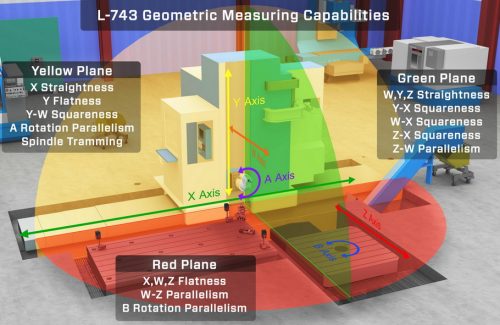
When envisioning how the system works, keep in mind that the L-743 and
L-733 systems are like having a ceiling and two walls, each 100' (30.5
meters) in radius and mutually perpendicular to each other.
Setting Up the Laser
The laser is either mounted on an instrument stand or on the table of
the machine. The system uses single-axis targets that have position-sensitive
detectors (PSDs) to pick up the center of energy of the laser beam, and
digital readouts to display the readings.

Measuring
Flatness
To measure flatness a "buck-in" (means to make parallel to)
procedure is followed.
First, a horizontal continuously rotating
laser plane is "bucked in" or adjusted so it is parallel to
3 reference points (see "Choosing
A Reference Point") on a table, set of ways or surface. To
accomplish this, the targets are all placed on one reference point,
adjusted up or down so they detect the laser plane and zeroed by hitting
the zero button on the readout. The targets are then repositioned so
that one target sits on each reference point.
Next, the laser scan plane is adjusted, using
the built-in pitch and roll adjustments, until all three targets produce
the same value or zero; thus making the laser parallel to the reference
points. This could also be accomplished by using one target, zeroed
on the closest reference point to the laser, and moving it back and
forth from the reference points until it produces a reading of zero
at all 3 points.
Finally, the target is moved to user-specified
points on the surface and the resulting reading is a measure of the
deviation from the reference point, helping to produce the flatness
profile. The measurement will show either a "+" or "-"
sign. A "+" reading means the target is higher than the reference
points and a "-" reading means the target is lower than the
reference points.
Measuring Straightness

To measure (horizontal) straightness of a surface or machine axis, 2 reference
points and one vertical laser plane are needed.
First, a target is mounted horizontally at
the closest reference point to the laser and adjusted so that it detects
the laser.
Next, it is zeroed and moved to the farthest reference point
from the laser. Using the yaw adjustment built into the laser, the laser
plane is adjusted so that it produces the same reading on both reference
points. The laser is now parallel or "bucked in" to the reference
points.
Finally, the target is placed at user-specified intervals along
the surface or machine axis and any deviations from zero are a measure
of straightness relative to the reference points. If the target is mounted
such that its top is to the left of the laser plane, then a "+"
reading means the measured point is to the "left" of the reference
points and a "-" reading means the point is to the right of
the reference points.
Measuring Squareness
After bucking in the laser to the 5 reference points as described above
and determining the flatness and straightness of the machine's axes, measuring
squareness is a simple process:
First, to measure Y-to-Z squareness, the
column/spindle is lowered to its lowest Z position and a target is positioned
horizontally to pick up the vertical laser plane that is perpendicular
to the X axis (parallel to Y axis).
Next, the target is zeroed and then the column is traversed (raised)
along its axis. The data will produce a measurement of both the straightness
of the Z axis and the squareness of Y axis to the Z axis.
Finally, to measure X-to-Y squareness, the same target setup
for the Z-to-X measurement is used. However, instead of raising the
column, the table or column (which ever is moveable) is then traversed
(moved) along the Y axis and the result is a measure of both Y straightness
and X-to-Y squareness.
The same process is followed for Z-to-X squareness except that the target
is positioned and zeroed to detect the vertical laser plane that is
parallel to the X axis. The column is traversed up again and the resulting
data is a measure of the Z "flatness" and Z-to-X squareness.
A note on squareness: To truly measure
squareness, one must compare the least-squares, best-fit line of the
one axis to the other axis. If this is not done, bad reference points
or severely worn ways might produce what looks like a squareness error,
but in fact is not. To facilitate this type of analysis, our software
programs may be used to automatically calculate the best-fit line.
Measuring Levelness
To simply measure levelness of a surface, the laser is leveled using the
built-in level vials. Then a target is placed on one reference point and
adjusted up or down so that it detects the laser plane. After zeroing
the target on the reference point, it is moved to any other point on the
surface and a measurement of levelness (flatness) is produced with the
target displaying the deviation of the measurement point from the reference
point.
Measuring Parallelism
To
measure parallelism of 2 surfaces using our the L-743 or L-733, the laser
plane has to be bucked in to 3 reference points on the first surface (see
Measuring Flatness above). After that, a target is placed on the second
surface on one reference point, adjusted so it detects the laser plane
and zeroed. It can then be moved to other points on the surface and any
deviation from the reference point is a measure of the parallelism of
the first surface to the second. At least 3 points should be measured.
However, the best way to determine parallelism is to measure both surfaces
with the laser plane and enter the data into our Plane5 software. Plane5
will calculate the least-squares best-fit plane for both surfaces and
then compare them, providing the best measure of parallelism. Another
benefit of Plane5 is that the "buck-in" procedure is not needed
because the software removes the slope error from the laser not being
parallel to the surface.
Analyzing Machine Geometry Data
Our Machine Tool Geometry Software analyzes lines of motion for a machine
tool, similar to the methodology used in ASME's B5.54 Standard. Our Plane
5 Software analyzes multiple planes and surface types (squares, rectangles,
frames, ways, circles and rings) and presents the analysis in 3D graphics.
Both sets of software automatically download alignment data, save data
analyses and produce alignment reports.
A word of caution: if the machine is going to be aligned,
rather than just measured, then it is important to put the laser on an
instrument stand. If the laser is on the machine bed or table, adjusting
it will most likely move the laser and thus affect the setup.
|


|
 |