

Martin Hamar was part of an engineering team PerkinElmer that invented the first laser alignment system in the first half of the 1960’s, and then, in 1967, launched a company dedicated to perfecting that technology. Hamar Laser Instruments, Inc. was born, and it remains on the cutting edge of laser alignment, solving problems from simple shaft alignment to complex multi-axis alignment integrated with automated control. Martin is a Cornell-educated engineer with 25 U.S. and foreign patents. He also knew how to show early customers that the quality of their parts depends on the precision of their tools. He proved it with the laser technology he pioneered, and the rest is history. “It was difficult in the beginning to sell the customer on the fact that he or she actually had a problem and that laser alignment was the solution,” he says, “but there are always a few who are willing to take a chance.”
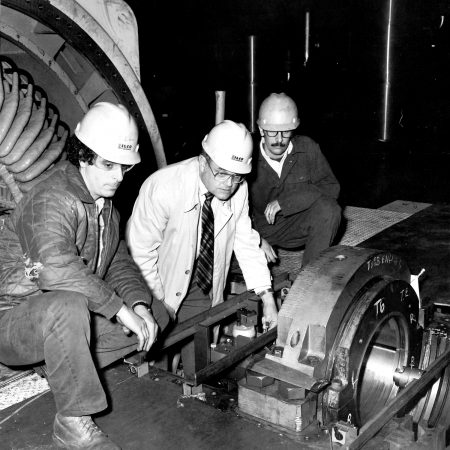
Martin’s very first laser alignment system, used for roll-grinding machines for the paper industry, was far ahead of its time. Yet he never stopped innovating, and his company has maintained a heavy emphasis on research and development to keep on top of the laser alignment industry. The next generation of Hamar products is in the very capable hands of the next generation of Hamars — namely Rod Hamar, who has continued Hamar’s single—minded focus on its alignment products: “Laser alignment is all we do; we work very hard at it. We eat, sleep and breathe accuracy but at the same time, relish a challenging application. We have seen a whole host of unique and challenging applications over the 59 years we’ve been in business and it is a rare day indeed when we are stumped!”
At Hamar Laser, precision is measured in microns and customer loyalty is measured in decades. We continuously engineer improvements into our lasers. Our quality standards are so demanding that it is not unusual for a Hamar laser to provide ten times the accuracy required by an application and for our systems to last 10, 15 or even 20 years.
Hamar Laser Instruments is a small company with a large presence. We serve diverse industries worldwide, including aerospace, automotive, power generation, plastics, ship building, food processing, pulp and paper, and steel manufacturing. Hamar Laser has been global for more than 20 years, supplying manufacturers on all five continents who demand state-of-the-art, precision lasers that are accurate, fast, and easy to use.
Today, the company sets the international standard for a variety of laser systems, starting with its automatically rotating laser plane. Since it was introduced in 1974, Hamar Laser has made dramatic improvements in the laser plane’s accuracy, performance and ease of use.
In 1992, with the introduction of the Triple Scan® Laser, the company set yet another standard of excellence, and again revolutionized the alignment industry by offering the world’s only 3-plane laser that can accurately check a machine tool in one setup! No competitor has even come close.
Whether you choose our top-of-the-line rotating laser, the L-743 Ultra-Precision Triple Scan® Laser, the L-703SP Surface Plate Calibration System, or our X-SERIES™ X-660, Wireless 3-Axis, entry-level shaft alignment system, you will receive a product that has 59 years of laser alignment experience in its design. Add to that our commitment to wireless communication across our product line and you have power alignment tools that can’t be matched. Our products have become so critical to our customers’ maintenance programs that we often hear them say “you need a Hamar for that!”
Hamar Laser Instruments headquarters is located in Danbury, CT. We invite you to drop by if you’re in the area, give us a call or better yet, send us a challenging application! The better you get to know us, the more precisely you’ll understand why our lasers are the industry standard.